
Jun 05 , 2025
Plate-type electrostatic mist elimination equipment achieves gas-liquid separation through physical collision and moisture absorption of flue gas, with condensed water collected under gravity. After simple modifications, the water absorption efficiency of the plates can be improved. By using polytetrafluoroethylene (PTFE) materials, the operational load on the blades can be reduced, thereby enhancing mist elimination effectiveness.
Electrostatic mist eliminators utilize high-voltage discharge to ionize flue gas, enabling the removal of ultrafine droplets through the directional movement of charged particles. Through technical improvements, such as adopting honeycomb-style precipitation electrodes, electrical efficiency can be enhanced, leading to higher mist elimination performance.
Pneumatic-enhanced mist elimination employs pressurization technology to increase the centrifugal force of flue gas under high pressure, achieving separation effects with mist elimination efficiency consistently maintained above 90%.
When selecting different mist eliminator types, it's crucial to match the right design with your specific application needs. In terms of technological investment, as new technologies and equipment are introduced, the costs of electrostatic mist eliminators and pneumatic-enhanced mist eliminators have shown a decreasing trend. Particularly, with the widespread application of enhanced pneumatic mist elimination and dust reduction flow guide components, not only has the outlet mist droplet content been reduced, but the cost has also dropped by approximately 40% compared to the initial equipment.
However, modified plate-type mist eliminators exhibit a significant increase in cost. For instance, replacing original blades with new ones results in a unit price increase of about ¥120 per blade. Therefore, from a cost perspective, electrostatic and pneumatic-enhanced mist eliminators are more economical, while plate-type mist eliminators have higher expenses.
After modifications, both plate-type and electrostatic mist eliminators have demonstrated notable improvements in ultrafine droplet absorption efficiency and in reducing "gypsum rain" and dust emissions. However, their performance still lags behind that of pneumatic-enhanced mist elimination.
For example, in terms of ultrafine droplet removal capability:
Plate-type mist eliminators can remove droplets up to 50μm in size.
Improved electrostatic mist eliminators can control the maximum removable droplet size within 10μm.
Pneumatic-enhanced devices, leveraging high-speed centrifugal action, can maintain the maximum removable droplet size below 3μm.
Against the backdrop of vigorously promoting energy conservation and emission reduction, in addition to pursuing higher efficiency, energy consumption is also a critical consideration for desulfurization tower mist elimination technologies. Among the three technologies discussed here, electrostatic mist eliminators have the highest energy consumption, followed by plate-type mist eliminators, while pneumatic-enhanced mist elimination technology demonstrates the most significant energy-saving effects.
In pneumatic-enhanced mist elimination systems, dedicated heat recovery and conversion devices are employed to reclaim heat from high-temperature flue gas, converting it into mechanical or electrical energy to support the operation of pneumatic equipment. Although external power supply is still required, the energy-saving and consumption-reducing performance is notably superior compared to the other two mist elimination technologies.

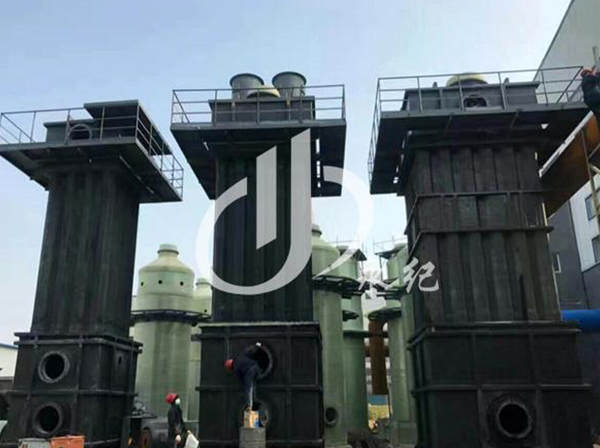
.webp "Prove Everything with Strength! (Dahua Project - Refined Acid Products)")


