May 09 , 2025
Industrial flue gas desulfurization primarily relies on tower-type equipment, commonly known as desulfurization towers. Initially, many desulfurization towers were constructed using granite masonry, operating on the water-film desulfurization and dust removal principle. These are also called granite water-film desulfurization dust collectors or masa stone water-film desulfurization dust collectors. Their advantages include easy maintenance and the ability to achieve simultaneous dust removal and desulfurization (or denitrification) by using tailored scrubbing solutions.
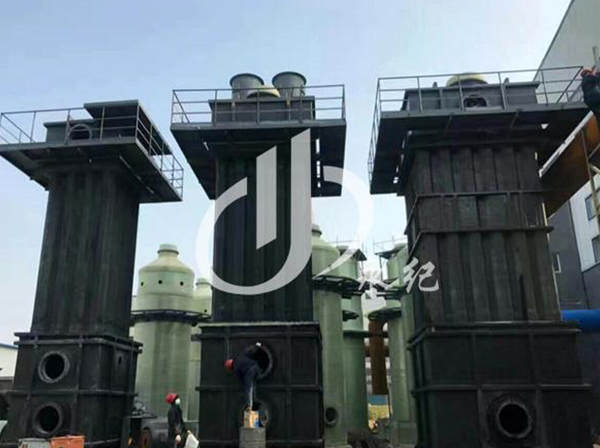
With advancements in fiber-reinforced plastic (FRP) technology, desulfurization towers are now increasingly made from FRP. Compared to granite towers, FRP desulfurization towers offer lower cost, easier fabrication, resistance to rust and corrosion, and lighter weight, making them the industry’s future trend.
Dust removal and desulfurization towers are designed for high-temperature resistance, acid/alkali corrosion resistance, anti-aging properties, high strength-to-weight ratio, and extended service life. These towers adopt a modular assembly design for easier transportation and installation, with the main structure made of modified high-temperature-resistant resin-based composite materials.
Both are used for coal-fired boiler flue gas treatment (desulfurization and dust removal).
1. Desulfurization Tower:
The circulation water tank is integrated with the tower body.
When the pH of the circulating water falls below standards, the solution is drained via the tank’s discharge port and replaced.
If the tower is also used for dust removal, accumulated dust cannot be discharged because the tower’s base is sealed—sediment settles at the bottom but cannot be cleared via the drain.
Thus, users typically install desulfurization towers after existing dust removal equipment (if sulfur removal is insufficient) or when the gas contains no particulate matter.
2. Integrated Desulfurization-Dust Collector:
Requires an external foundation pool for installation, as the collector has no bottom cover (open-base design).
Water circulation relies on the foundation pool. Since the device handles both desulfurization and dust removal, settled dust accumulates in the pool.
Manual ash-clearing is periodically needed to maintain purification efficiency once sediment reaches a certain level.
Desulfurization towers are not recommended for standalone dust removal. For combined desulfurization and dust removal, FRP integrated desulfurization-dust collectors are the preferred choice.